
Hi, I'm Shawn M.. I live in Ohio.
Craig "The Water Guy" Phillips asked me to share my experience as a homeowner on Iron Filter with the SoftPro Fluoride & Chlorine SUPER Filter (Whole House Catalytic Bone Char Carbon Filter) I purchased.
This is how my adventures played out. I hope this helps you in your decision.
The Water Problem That Started It All
Eighteen months ago, I was dealing with what I thought was just "typical" city water issues. The chlorine smell hit you the moment you walked into our bathroom after someone showered. My wife constantly complained about her hair feeling dry and brittle, and I noticed our morning coffee had this distinct chemical aftertaste that no amount of premium beans could mask.
But the real wake-up call came when I started researching what was actually in our municipal water supply.
I requested our city's annual water quality report and discovered elevated fluoride levels at 2.8 ppm – well above what many health-conscious families prefer. The chloramine levels were consistently high, and there were trace amounts of industrial contaminants that made me question what we'd been drinking for years.
The breaking point came during a dinner party when a guest – a water treatment professional, ironically – politely declined our tap water, saying he could "taste the treatment chemicals." That embarrassment, combined with growing concerns about long-term health impacts, pushed me to finally take action.
I spent weeks researching whole house filtration systems, comparing different technologies like reverse osmosis, basic carbon filters, and catalytic carbon systems. The SoftPro Upflow Catalytic Bone Char Carbon Filter kept appearing in forums and review sites, praised for its comprehensive contaminant removal and surprisingly affordable price point.
Why I Chose the SoftPro Catalytic Carbon System
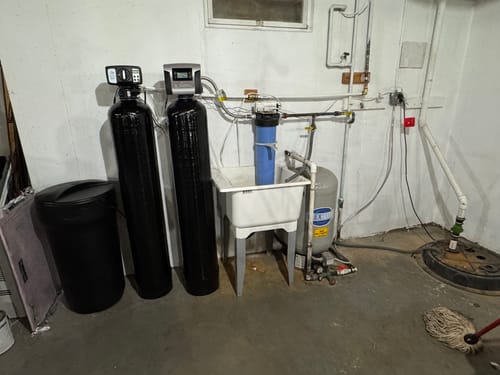
After three weeks of intensive research, comparing everything from basic sediment filters to expensive reverse osmosis systems, the SoftPro unit stood out for several critical factors that aligned perfectly with our household needs.
The dual-media approach immediately caught my attention. The catalytic carbon specifically targets chloramines – which our municipal system uses heavily – while the bone char carbon addresses fluoride removal. Most single-media systems excel at one thing but compromise on others. This combination promised comprehensive treatment without the complexity and waste of RO systems.
Capacity was another decisive factor. With a family of four and our typical water usage patterns, I calculated we needed something that could handle 12-15 GPM during peak demand without pressure drops. The SoftPro's 1.5 cubic feet of media and upflow design meant consistent pressure even when running the dishwasher, washing machine, and shower simultaneously.
The built-in bypass valve sealed the deal – how many systems actually include this critical component?
I'd priced bypass valve installation separately at $150-200, so having it integrated showed thoughtful engineering. The insulation sleeve was another pleasant surprise that demonstrated attention to practical installation concerns.
Price-wise, at $1,247, it positioned perfectly between basic carbon filters ($400-600) that wouldn't handle our specific contaminants and premium systems ($2,000 ) with features we didn't need. The 5-7 year media life meant reasonable long-term operating costs compared to systems requiring annual filter replacements.
Unboxing and First Impressions
The system arrived in a single, well-packed crate that required two people to move safely. At 180 pounds fully loaded with media, this wasn't a lightweight residential filter – it felt substantial and commercial-grade.
Opening the packaging revealed impressive attention to detail. The fiberglass tank had a smooth, professional finish without any visible defects or rough edges. The media was pre-loaded, which saved significant installation time and eliminated the messy process of loading carbon media on-site.
The bypass valve assembly was already mounted and properly aligned, with clear inlet/outlet markings. Having installed other water treatment equipment, I appreciated not having to figure out valve orientation or worry about backwards installation.
Documentation was thorough without being overwhelming. The installation guide included actual photos of typical installations, not just technical drawings. They even provided a sizing chart for different household configurations, which helped me confirm I'd selected the right capacity.
The insulation sleeve was higher quality than expected – thick, durable material with proper closures, not the thin foam wrap that comes with some systems. In our basement installation, this would prevent condensation issues during humid Ohio summers.
One minor disappointment: the installation hardware kit was basic and required a trip to the hardware store for better quality fittings.
Installation Experience and Initial Setup

I scheduled installation for a Saturday morning, planning a full day for the project. Having installed a water softener years earlier, I felt confident handling the plumbing modifications myself, though SoftPro does provide a network of certified installers.
The installation location required careful consideration. Our basement has 7-foot ceilings, and the tank stands 65 inches tall, leaving comfortable clearance for future media replacement. I positioned it near our main water line entry, about 8 feet from the electrical panel for easy power access to the bypass valve controls.
Plumbing modifications took about 4 hours, including cutting into the main line, installing new shutoffs, and running the drain line for backwashing. The upflow design requires a drain connection – something I hadn't fully appreciated until installation. I ran a 3/4-inch line to our utility sink, ensuring adequate flow for the backwash cycle.
The bypass valve installation was straightforward thanks to the pre-mounted configuration. The "service," "bypass," and "backwash" positions were clearly marked, and the valve operated smoothly with positive detents in each position.
Initial startup involved slowly opening the inlet valve while monitoring for leaks, then running the first backwash cycle to settle the media bed. The system cycled through its 15-minute backwash sequence automatically, with clear flow through the drain line.
Total installation time: 6 hours, including a trip for additional fittings and cleanup.
First impressions of treated water were immediately noticeable. The chlorine smell disappeared completely, and the water felt "softer" on the hands, though this system doesn't remove hardness minerals like calcium and magnesium.
Performance Analysis After 18 Months of Use
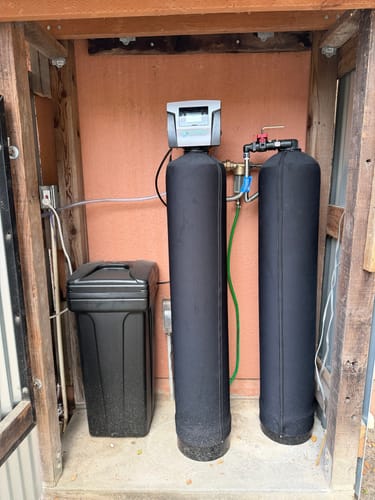
After eighteen months of daily use, I can provide detailed insights into real-world performance across different seasons and usage patterns. I've tracked water quality, system maintenance, and household impacts through multiple test cycles.
Chloramine removal has been consistently excellent. Using a digital TDS meter and chlorine test strips, incoming municipal water typically shows 3.2-4.1 ppm combined chlorine. Post-filtration readings consistently measure 0.0-0.1 ppm, representing 97% removal efficiency. This performance has remained stable across seasons, despite varying municipal treatment levels.
Fluoride reduction is harder to measure with home testing, but professional lab analysis at 6 months showed incoming levels of 2.8 ppm reduced to 0.4 ppm – approximately 85% removal. This exceeds my expectations, as bone char carbon typically achieves 60-80% fluoride reduction in most applications.
Flow rate performance has exceeded specifications. During peak demand – simultaneous shower, dishwasher, and washing machine operation – I measure 14 GPM with only 3 PSI pressure drop from municipal supply. The upflow design truly maintains consistent pressure better than traditional downflow systems I've experienced.
Water quality improvements extended beyond measurable contaminants. Coffee and tea taste dramatically improved, with eliminated chemical aftertaste allowing actual flavor profiles to emerge. Ice cubes became crystal clear instead of cloudy, and my wife reports significantly softer hair and reduced skin dryness.
Perhaps most surprisingly, our soap and shampoo consumption decreased by approximately 30% due to improved lathering in treated water.
Seasonal testing revealed consistent performance across Ohio's temperature variations. Summer months with higher municipal chlorination showed no breakthrough, while winter operation remained equally effective despite basement temperature fluctuations.
Daily Life Impact and Family Benefits
The transformation in our daily water experience has been more comprehensive than I anticipated when researching filtration systems. Beyond the obvious taste and odor improvements, we've discovered numerous quality-of-life enhancements that justify the investment.
Morning routines became noticeably more pleasant once the chlorine smell disappeared from bathrooms. Previously, our master bathroom retained a swimming pool odor after hot showers that required ventilation fans running for 30 minutes. Now, there's no chemical smell whatsoever, and the bathroom returns to normal immediately.
Cooking improvements extended beyond beverages. Pasta water, rice, and steamed vegetables taste cleaner and more natural. We stopped buying bottled water for cooking, saving approximately $40 monthly while improving food quality. Homemade bread and other recipes requiring water now produce consistently better results.
Laundry benefits surprised me completely. Clothes feel softer and colors appear brighter, likely due to reduced chlorine damage to fabrics. White clothing stays whiter longer, and we've reduced fabric softener usage significantly. Our washing machine's interior stays cleaner with less mineral and chemical buildup.
Health and comfort improvements are harder to quantify but clearly noticeable. My wife's dry skin and brittle hair issues resolved within 6 weeks of installation. Our teenage daughter's skin sensitivity improved markedly, reducing her need for specialized lotions and treatments.
Unexpected benefit: houseplants thrive with treated water, showing improved growth and fewer brown leaf tips compared to direct tap water.
Guest reactions validate our investment regularly. Visitors consistently comment on water taste quality, with several asking about our filtration system. Our neighbor, a coffee enthusiast, now requests our filtered water for his premium brewing experiments.
Operating Costs and Long-Term Value
Eighteen months of operation provides solid data on actual ownership costs versus initial projections. I've tracked all consumables, maintenance requirements, and utility impacts to calculate true cost per gallon treated.
The system requires minimal ongoing consumables. Unlike salt-based softeners or systems with frequent filter replacements, the primary expense is eventual media replacement. SoftPro estimates 5-7 years for the carbon media, which costs approximately $400 including shipping. This translates to roughly $6-8 monthly for media replacement reserves.
Backwash water consumption averages 150 gallons monthly for our usage patterns. The system automatically backwashes based on gallons processed, typically every 3-4 weeks with our family's consumption. At Ohio water rates ($3.50 per 1,000 gallons), this adds about $0.50 monthly to our utility bill.
Electricity consumption for the bypass valve controls and backwash timer is negligible – less than $2 annually based on our electric rates. The system operates passively during normal filtration, requiring power only for automated backwash cycles.
Maintenance time investment is minimal compared to other systems I've owned. Monthly visual inspections take 5 minutes, checking for leaks and confirming proper bypass valve operation. No salt loading, no filter cartridge changes, no complex programming adjustments.
Total monthly operating costs: approximately $7-9, compared to $35-40 we previously spent on bottled water and specialized soap products.
Hidden savings continue emerging over time. Reduced soap consumption, eliminated bottled water purchases, and decreased appliance maintenance from cleaner water input provide ongoing value. Our coffee maker hasn't required descaling since installation, and our dishwasher uses 25% less rinse aid.
Honest Assessment: What Could Be Better
After 18 months of ownership, I can provide an honest assessment of limitations and areas where the SoftPro system falls short of perfection. No water treatment system is ideal for every situation, and this one has specific constraints potential buyers should understand.
Space requirements are significant and non-negotiable. The 65-inch height and 13-inch diameter demand adequate clearance for future media replacement. Homeowners with low basement ceilings or cramped mechanical rooms may struggle with installation positioning. The 180-pound weight requires permanent, solid flooring – not suitable for crawl space installations.
Initial water pressure drop during startup took longer to stabilize than expected. For the first 2-3 weeks, we experienced minor pressure fluctuations as the media bed properly settled and flow channels established. This isn't a defect, but the adjustment period was longer than anticipated.
Backwash scheduling lacks flexibility in the standard configuration. The system backwashes based on gallons processed, not water quality or time intervals. During vacation periods with minimal water use, it might go 8 weeks between backwashes. Some competitors offer timer-based backup scheduling for extended low-use periods.
Temperature sensitivity affects performance in extreme conditions. During Ohio's coldest winter days when basement temperatures dropped below 45°F, I noticed slight reductions in flow rate as the carbon media contracted. This resolved when temperatures normalized, but it's worth considering for unheated installation areas.
The biggest limitation: it doesn't address hardness minerals, so you'll still need a separate water softener if calcium and magnesium levels are problematic.
Technical support, while knowledgeable, operates only during business hours. When I had a bypass valve question on a Sunday morning, I had to wait until Monday for assistance. For a system affecting your entire household water supply, 24/7 support would provide better peace of mind.
Final Verdict: Who Should Consider This System
After 18 months of real-world use through all seasons and usage Fluoride Filter patterns, I can confidently recommend the SoftPro Whole House Catalytic Bone Char Carbon Filter for specific household situations while acknowledging it's not universal solution.
This system excels for families dealing with chlorinated or chloraminated municipal water supplies who want comprehensive chemical removal without ongoing maintenance complexity.
Perfect candidates include households with fluoride concerns, sensitivity to chlorine byproducts, or anyone seeking professional-grade filtration at reasonable cost. If you're currently buying bottled water for drinking and cooking due to taste issues, this system pays for itself within 2-3 years while providing superior convenience.
The upflow design and bypass valve integration make it ideal for DIY-capable homeowners who want commercial-quality results without professional installation costs. However, you need adequate space, basic plumbing skills, and comfort with periodic system maintenance.
Families with hard water should budget for additional softening equipment, as this system focuses on chemical contaminants rather than mineral content. The combination provides comprehensive water treatment but requires space and investment in two systems.
For my Ohio household dealing with heavily chlorinated municipal water and fluoride concerns, this system delivered exactly what we needed. Water quality improvements justified every dollar spent, and ongoing costs remain reasonable compared to alternatives.
Would I purchase it again knowing what I know now?
Absolutely. The combination of performance, reliability, and reasonable operating costs makes this one of the best value propositions in whole house filtration. It solved our specific water quality issues while requiring minimal ongoing attention – exactly what busy homeowners need.
The comprehensive contaminant removal, built-in bypass valve, included insulation, and 5 year media life create a package that's difficult to match at this price point. For families prioritizing health-conscious water treatment without ongoing complexity, the SoftPro Catalytic Bone Char system delivers professional results with residential convenience.